Dehumidifiers, air movers and readings

Structural Drying and Dehumidification in San Juan Capistrano

Drying is the part of water damage that decides whether a house is truly dry. In San Juan Capistrano it follows moisture readings and a measured goal, not a guess or a set number of days.

(888) 450-9281Call about drying
Air movers and LGR dehumidifiers Daily readings logged Dry goal documented
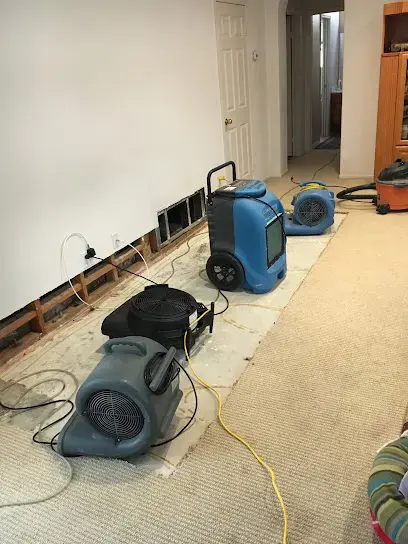
Air movers and a dehumidifier drying carpet beside a flood-cut wall, shown for San Juan Capistrano structural drying
Right now

First steps for structural drying and dehumidification in San Juan Capistrano

  1. 1

    Stop the water first

    Drying cannot succeed while water is still entering.

  2. 2

    Keep the room closed

    Close doors and windows so the dehumidifier works on the wet room.

  3. 3

    Leave the equipment alone

    Do not unplug or move the air movers.

  4. 4

    Allow the visits

    Technicians return to take readings and adjust equipment until the goal is met.

Structural drying is the process of removing moisture that has soaked into framing, drywall, subfloors and flooring. Extraction removes standing water, but materials keep holding water inside, and drying equipment is what pulls it out under controlled conditions.

How structural drying works

Drying relies on moving air across wet surfaces while dehumidifiers remove the moisture from the air, so the rooms are kept closed and the conditions are watched.

  • Air movers push dry air across floors and wall faces to lift moisture off the surface.
  • LGR dehumidifiers pull that moisture out of the air and keep humidity low enough for drying to continue.
  • Desiccant units or floor mats are added for dense materials such as hardwood and slab, which release water slowly.
  • Cavity drying systems push air through opened wall bottoms and ceiling spaces to reach what the room air cannot.
Typical cost ranges

What does structural drying and dehumidification cost in San Juan Capistrano, CA?

Drying cost depends on the class of the loss and the materials. A small area with simple materials is the lowest band, several rooms with wet walls sit in the middle, and hardwood or slab drying sits at the top.

Light loss, one area

$1,400 to $3,500
  • Air movers and an LGR dehumidifier
  • Readings at every visit
  • Short monitoring period

Heavier loss, several rooms

$3,500 to $7,500
  • Walls and ceilings dried too
  • More equipment in each room
  • Psychrometric logs kept

Dense materials, hardwood or slab

$6,000 to $12,000
  • Desiccant units or floor mats
  • Longer drying period
  • Cavity drying systems in walls

Ranges are typical figures, not a quote. The category of water, the square footage, the material class and how fast drying started move the number most. The water damage cost calculator gives a closer range.
Step by step

How structural drying and dehumidification is handled in San Juan Capistrano

The tech who does the walkthrough finds the source and maps the moisture before equipment goes down, and the drying team keeps it running until the readings say dry.

  1. 1

    Map the moisture

    Meters and a thermal camera show which materials are wet and how far the water went.

  2. 2

    Size the setup

    Air movers and dehumidifiers are matched to cubic footage and the class of the loss.

  3. 3

    Run and adjust

    Units run around the clock, and technicians reposition them as the readings change.

  4. 4

    Confirm the goal

    Final readings are compared with the dry reference, and equipment is removed.

Classes of water loss and equipment

Equipment is sized by the class of the loss, which describes how much of the structure is wet and how slowly the materials release water. A single wet room needs less than a house with saturated walls, ceilings and hardwood.

Older buildings and the Los Rios district

The Los Rios Historic District dates to the late 1700s and sits on the National Register of Historic Places. Buildings of that age call for gentler drying, with moisture mapped before demolition, original materials saved wherever readings allow and heat kept moderate on delicate finishes.

Newer homes in Mission Flats or San Juan Hills Estates follow the same readings, with less concern for fragile finishes.

How the end of drying is decided

Readings on a dry reference material in an unaffected area set the target, and each wet material is read against it. No fixed number of days applies, because the calendar does not tell when a stud or a floor is dry. Equipment is removed only when the numbers say so.

See the water extraction page for the step before drying and the commercial water damage page for larger buildings.

San Juan Capistrano, CA service area
Service area

Structural drying and dehumidification across San Juan Capistrano and nearby towns

Structural drying covers ZIP codes 92675 and 92693, including Los Rios, Mission Flats, San Juan Hills, Campanilla and the homes and shops along Camino Capistrano and Ortega Highway.

The same service nearby: structural drying and dehumidification in Laguna Niguel, Dana Point, Laguna Hills.

Water damage restoration in San Juan Capistrano · every town covered

Answers

Structural Drying and Dehumidification questions in San Juan Capistrano, CA

Why does the equipment keep running after the water is gone?

Extraction removes standing water, but framing, drywall and floors still hold moisture. The equipment keeps pulling it out until the readings reach the dry goal.

Can the house be dried without dehumidifiers?

Not reliably. Air movers alone only move moisture into the air, so dehumidifiers are needed to take it out and keep drying going.

Is the noise and heat normal?

Yes. Running equipment is loud and warms the room, which helps drying. Units are adjusted as readings change, not switched off for quiet.

How is a historic building dried?

With extra care. Moisture is mapped first, original materials are kept where possible and heat is moderated for delicate finishes, as in older Los Rios buildings.

What do the daily readings show?

Temperature, humidity and moisture content of each wet material. They show whether drying is moving toward the goal and when equipment can come out.

Can wet materials be left to dry on their own?

Small amounts might, but wet drywall, pad and framing often stay damp for a long time. Controlled drying avoids lingering moisture that causes later damage.

Still dealing with it?

Water gone but rooms still damp? Describe the rooms and the drying plan is set.

(888) 450-9281Call about drying
24/7 emergency dispatch

Dry the structure in San Juan Capistrano

Dispatch runs around the clock. Say what was wet, what the floors and walls are made of and whether extraction is finished, and the equipment plan starts from there.

(888) 450-9281Call for drying help
Call (888) 450-9281 · 24/7